

Karakum Desert Adventure 2 Days 1 Night

Start: Dashoguz border - 10 May 2026
End: Dashoguz border - 11 May 2026
Type tour: 02 Days 01 Nights
Payments: By request
Group: 4

About tour

This tour takes you on an unforgettable adventure through Turkmenistan’s natural and historical wonders. Experience the fiery Darvaza Gas Crater, also known as the "Door to Hell," and explore the ancient UNESCO-listed ruins of Kunya-Urgench, a once-thriving Silk Road city.

Itinerary

  • Meeting at the border Shavat/Dashoguz border. (1 hour)

    After drive to Darvaza Gas Crater (270 km, 5-6 hours’ drive)

    On the way stop take some photos Karakum Desert Flora and Fauna.

    The Karakum is a sand desert stretching for 350,000 km2 from the Caspian Sea to Pamir foothills and from Amu Darya to Kopet Dag ridge. Its name is translated as “black sands” (“kara” - black, “kum” - sand). The dessert corresponds to its gloomy name, because some of its parts were previously completely waterless for hundreds of kilometers, and anyone who tried to cross it, found a terrible death under the scorching sun of Asia. Flora is represented by the sand sedge, acacia, saksaul, and in spring, by grasses and flowers which cover huge areas, except for dunes, and completely dry up by May. Fauna of the Karakum desert includes gazelles, foxes, wolves, various rodents, lizards, snakes and insects. Besides the wildlife, grassland farming to raise sheep and camels is also common there.


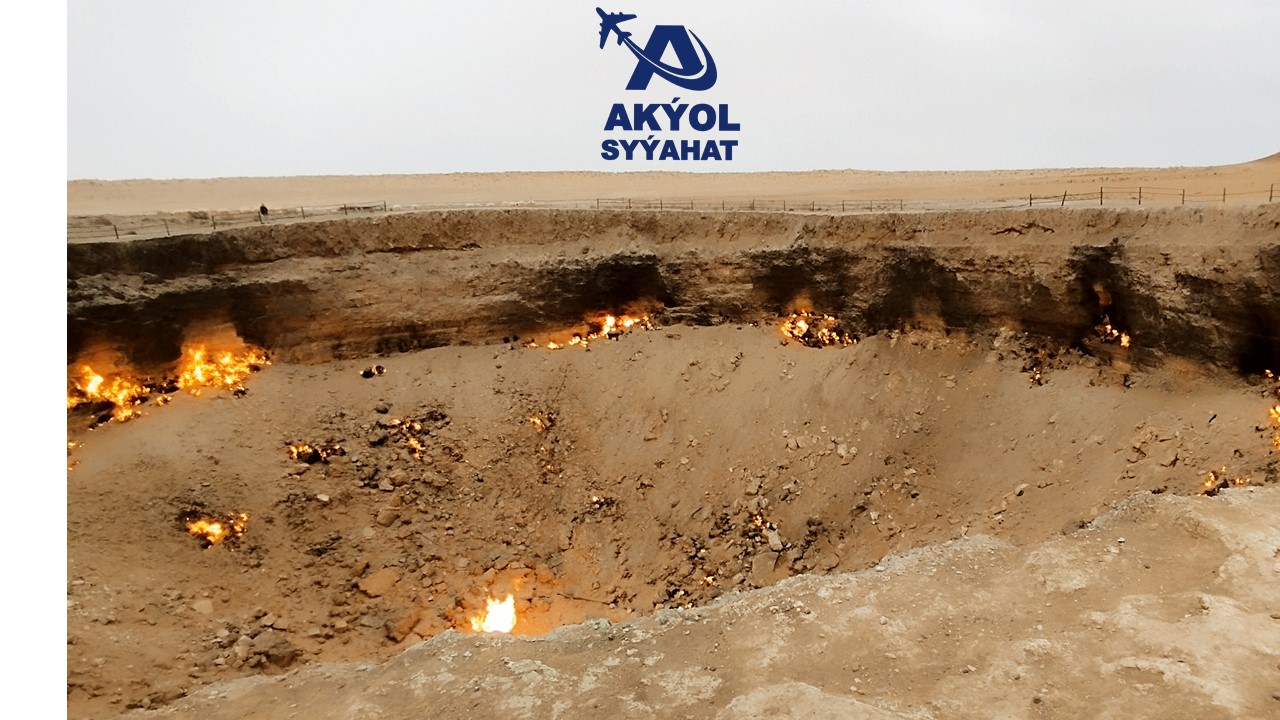
    The Darvaza gas crater also known as the Door to Hell or Gates of Hell, officially the Shining of Karakum, is a burning natural gas field collapsed into a cavern near Darvaza, Turkmenistan. Hundreds of natural gas fires illuminate the floor and rim of the crater. The crater has been burning since 1971. Drilling punctured a natural-gas cavern, the cavern’s roof collapsed, and some sources state that engineers ignited the crater to prevent poisonous gases from spreading. The crater is near the village of Darvaza in the middle of the Karakum Desert.

    Barbeque style dinner.

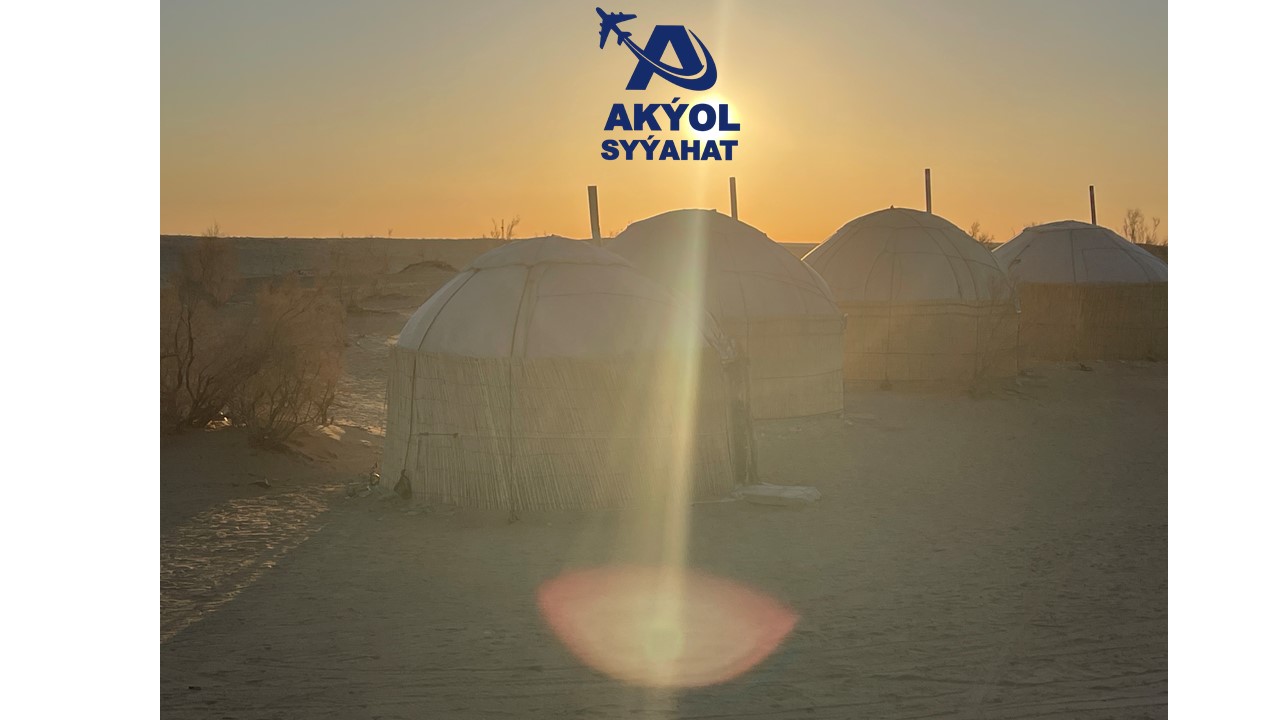
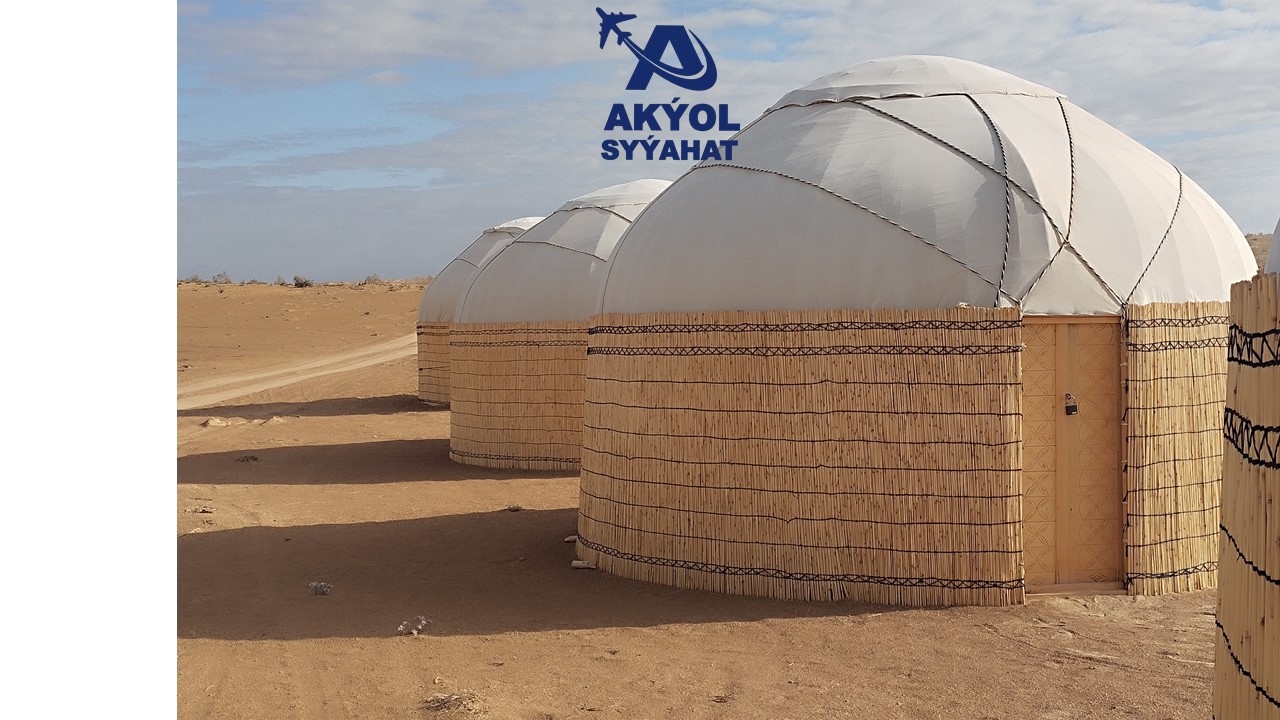
    OVERNIGHT AT CAMP (YURTA)


    NOTE: We offer at Darvaza Gas Crater BBQ style menu.

    Barbecue (BBQ) or Shashlik: This is the most common and traditional offering. Our guide and driver will prepare "nomad-style kebabs" or grilled skewers (shashlik) over an open fire. Meats are usually lamb or chicken.

    Meals are universally accompanied by fresh bread, salads, and sometimes roasted vegetables like potatoes or eggplant.

    Dessert in the Desert: Turkmen Melons and watermelons: If traveling during the harvest season (late summer/early autumn), the famous, incredibly sweet Turkmen melon and watermelon is the country's most beloved natural dessert and is often served.

    For breakfast, we offer boiled eggs, yogurt, fruits, jam, bread, tea, and coffee.

    Vegetarian/Dietary Needs: Because meals are prepared in advance, you must inform our tour operator well ahead of time of any dietary restrictions (vegetarian, vegan, allergies). They can usually accommodate with things like simple vegetable plov or grilled vegetables (tomatoes, eggplant, sweet pepper).


  • After early breakfast drive ~300 km & 6-7 hours to Koneurgench-the capital of Khorezmshahs.

    Kunya-Urgench (Keneurgench) is an ancient city, the first mention of which dates back to the III-I centuries BC. It is found even in the Avesta, the main book of the Zoroastrians. There the city is called Urva (Urga). Caravans of the Great Silk Road passed through here, and the Chinese called the city Yue-gan, although it was located on the territory of the state of Khorezm. In the VIII century, the Arabs conquered the city and renamed it Gurganj. At the same time, the Khorezm ruler settled in Gurganj, declaring the city his residence. At various times, Gurganj was conquered by the Mamunids, Anushteginids and even Genghis Khan himself. The latter conquered Gurganj in 1221, severely destroying the city. In the XIV century, the city became subordinate to the Uzbek Khan - Sultan of the Golden Horde. Then, according to the merchant-traveler Ibn Batuta, Gurganj became the largest of the Turkic cities. All the attractions of Kunya Urgench are located in the Old Town and are included in the UNESCO World Heritage List. Once the caravans of the Great Silk Road passed here. Today, several buildings of the XI-XVI centuries have been preserved in the city.


    Mausoleum of Turabek-Khanym there is also a mausoleum of the XIV century, where the daughter of Uzbek Khan - Tyurabek-khanym is buried. The mausoleum is interesting with a dome mosaic panel depicting flowers and stars. It is believed that this ornament has no analogues. 

    Kutlug Timur Minaret the Kutlug-Timur minaret, erected in the XIV century, is considered the tallest in Central Asia. Its length is 60-62 meters (the figures vary slightly depending on the sources). Once the majestic minaret was part of a mosque that was destroyed. 

    Mausoleum of Sultan Tekesh near the minaret of Kutlug-Timur there is the mausoleum of Sultan Tekesh - one of a few survived monuments of pre-Mongol Kunya-Urgench. The people call it Sherepbaba and Gyok-Gumbez. Together with the mausoleum of Il'-Arslan they constitute the necropolis of one of the ruling Khoresm clans. 

    Mausoleum of Il-Arslan this unique architectural construction also called the mausoleum of Fakhreddin Razi has survived by a miracle. It had been constructed before the Mongol invasion to Kunya-Urgench. The form of the mausoleum is distinguished by precision and simplicity of composition: a cube with a 12-side drum prism on it and external dome in the form of 12 - side tabernacle.

    The Mausoleum of Il-Arslan was manually decorated with a relief carved terracotta expressed in an intricate ornament: vegetative and geometrical patterns. While decorating, a special medieval technique was applied. Raw bricks lying on the ground were covered with clay which was used for creating the most complicated relief ornament. Then the entire composition was cut in seams between the bricks and fired to be further assembled on facade. 

    Minaret of Mamun during excavation works of a hill in Kunya-Urgench near the mausoleum of Il'-Arslan the remains of the minaret which had fallen only about a hundred years ago were found.

    In 1900 the local residents found a foundation lead slab with a text saying that the minaret had been constructed in 1011 by the order of Mamun shakh. 

    Kyrk Molla the sacred hill Kyrk Molla, “40 mullahs” in Turkic, is found in Kunya Urgench. It is located to the north-east from the city, near the Sultan Tekesh Mausoleum. The hill area is about 3 ha and its maximum height is 12.5m.

    This place is the ancient center of Gurganj (an old name of Kunya-Urgench). The excavations there revealed a vallum of the ancient period and an altar. In the Middle Ages on the site of the hill there was the famous Mamun Library. 

    The Mausoleum of Nadzhimetdin Kubra is the founder of the dervish order "Kubraviya" in Islam, a Sufi sheikh - the main monument in the memorial complex "360". This place is considered holy. Pilgrims from all world pay visits there.

    According to the legend, Horesmshakh Mohammed II executed of one of the best Kubra's pupils after by a false denunciation. The holy man got angry and damned Khoresm. The damnation soon come true - the mighty state fell under aggressive Mongol invasion. Kubra himself and his 360 pupils fought side by side to protect their city. This battle was the last heroic deed of Nadzhimetdin for the glory Islam: a Mongolian warrior beheaded the holy man. The cemetery in Kunya Urgench, where today the Mausoleum of Nadzhimetdin Kubra and the mausoleums of Sultan Ali and Piryarvali stand, was built on the site of the battle. Right beside them is the grave of young Dzhamildzhan, Nadzhimetdin Kubra 's favorite pupil.  

    Then drive approximately 110 km and 1.5 hours back to Dashoguz. Lunch at a local restaurant.

    After lunch, drive to the Dashoguz/Shavat border. Crossing border


Included

  • Darvaza - yurt - 1 night
  • Services of A/C comfortable transport with professional driver as per the program
  • English speaking local guide
  • Daily 4 bottles of 0.5l water per person
  • BBQ style dinner and breakfast at Darvaza crater
  • Entrance fees to mentioned sights per program (excluding photo and video charges at sights)
  • Visa support to Turkmenistan, registration and travel pass
  • Travel tax
  • Handmade souvenir per person

Excluded

  • Visa consular fees and processing expenses 80+15 USD per person, when obtained at land border (subject to change, nationality dependent)
  • Turkmenistan migration tax 14 USD per person
  • PCR nose test 33 USD
  • Photo and video charges at sights
  • Beverages
  • Travel Insurance
  • Extras, not indicated in inclusions

Additional info

Notes:
An express PCR test for Covid-19 will be taken upon arrival. It costs 33 USD (subject to change)

Customer Support

We have a professional customer support team and always accompany you on every trip.

Karakum Desert Adventure 2 Days 1 Night
Reserve now and pay later to book your spot and pay nothing today

Ashgabat
London
New York
Paris
Tokyo
Beijing