



Crossing Turkmenistan: Ashgabat–Farap Route
About tour
Tour Highlights White Marble Capital: Tour Ashgabat, the city with the highest density of white marble in the world. Discover Turkmenistan's beautiful nature and ancient monuments, as well as national traditions and local cuisine. UNESCO Explore Ancient Merv and the Parthian Fortresses of Nisa. Gonur Depe (2000 BC) is the largest settlement in historical Margiana, also known as Margush. Dayahatyn along Great Silk Road: The Great Silk Road is a grandiose trade route that links the East and West and became the cause of origin of many unique cities, architectural structures, customs and even states.
Itinerary
-
Arrival in Ashgabat International Airport by Turkmenhowayollary Airlines at 09:40
Tour guide will meet you and transfer to the hotel.
We will begin our tour in Ashgabat. Ashgabat is a relatively young city in 25.05.2013 city was included Gunnies Book of records as a white marbled city on the world.
11:00 – Ashgabat sightseeing:
The State Museum of the State Cultural Center of Turkmenistan is the first and largest one of the 26 museums established following the independence of Turkmenistan. The official opening took place on 12 November 1998. It is located on Archabil Avenue in the picturesque Kopet Dagh foothills. Opposite the museum there is the main flag of Turkmenistan attached to one of the highest flagpole in the world.
Independence Park if you once find yourself in Ashgabat, the city of love, white marble and thousands of fountains, you must visit the main park in the Turkmen capital - National Independence Park. This Park is one of the city’s attractions, embodying the spirit of modern Turkmenistan.
Arch of Neutrality used to stand on the main square of the country, but in 2011, was moved to Ashgabat’s outskirts. Still worth a visit, this multi-level structure is crowned by a sculpture of the former Turkmenistan´s President, Saparmurat Niyazov. Previously, the sculpture used to rotate after the sun, making a daily full turnover.
The Hotel “Bagt Koshgi” that from Turkmen language means “The temple of Happiness” is a part of a Wedding Palace with the same name located in 5 km from the centre of Ashgabat. This unique building of an unusual shape was opened in 2011 and besides the hotel includes six luxurious halls for marriage registrations, seven banquet halls, numerous shops and other different facilities necessary for wedding arrangement such as beauty salons, wedding dress boutiques, photo booths, and many others. “Bagt Koshgi “complex is an 11-storey building consisting of solid foundation on which a cube with octagonal sides stands, and this unusual figure can hold inside a huge ball with a diameter of 32 meters.
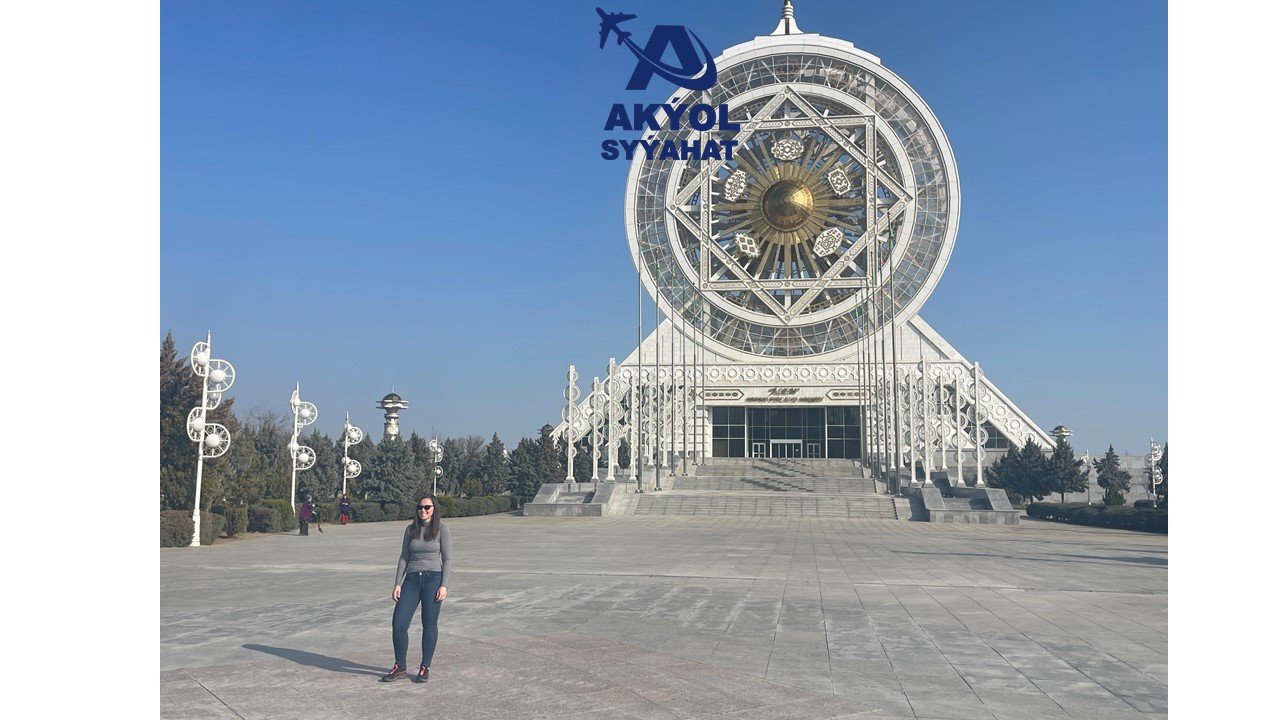
The Ferris Wheel in Ashgabat, known as the Giant Wheel, is an iconic landmark that complements the city’s modern skyline. From a height of about 40 metres, it offers a stunning panoramic view of Ashgabat and the surrounding landscape. Located in the heart of the city centre, the Ferris wheel is part of the large ‘Independence Park’, which features beautifully landscaped gardens, fountains and various recreational facilities. The giant wheel is particularly enchanting at night when it is lit up with multi-coloured lights, creating a vibrant atmosphere. It is an ideal place for families, couples and anyone who wants to admire the breathtaking views of Ashgabat, especially at sunset. This attraction symbolizes the rapid development of Turkmenistan‘s capital city and its desire for modernity, and provides a fun and enjoyable experience for all ages.
The Constitution Monument, in Ashgabat, stands as a symbol of the nation’s commitment to democracy and the rule of law. Unveiled in 2011, the monument celebrates the significance of the Constitution of Turkmenistan, which was adopted in 1992.Design and Features of the monument features a grand architectural design, characterized by its towering structure that represents the ideals of freedom and governance. The central element of the monument is a large, open book symbolizing the Constitution itself, with the text inscribed on its pages. Surrounding the monument are beautifully landscaped gardens, enhancing the monument’s prominence and serving as a peaceful gathering place for citizens and visitors.
Night at the hotel.
-
BREAKFAST
09:00 – After breakfast continue sightseeing Ashgabat:
The Turkmenbashi Ruhy Mosque eleven kilometers to the west of Ashgabat there stands one of the largest mosques in Central Asia and main mosque of Turkmenistan – The Turkmenbashi Ruhy Mosque. Like all other buildings of the period of independence it differs with its immensity and grandiosity.
Old and New Nisa 18 km from the city of Ashgabat in the outskirts of Bagir village there is a unique ancient monument, the ruins of ancient settlement Nisa. It used to be the capital of Parthia which had existed from the third century B.C. to the third century A.D. The Historical complex includes two archeologic monuments - Old and New Nisa.
Akhalteke Horse Farm the horse farm is located in the countryside area, behind the GeokDepe town, 55km. Excursion at the farm to see the AkhalTeke horse and Turkmen dog Alabay. Akhal-Teke horse farm – home to the world-famous Turkmen horses. Learn about the breeding traditions and history of Akhal-Teke horses. Here, experts will tell you about Akhal-Teke horses. Next to the farm, you can take a horseback ride through the gardens.
Underground lake Kov-Ata, located 107 km from Ashgabat.The Turkmen name Kov-Ata means Father of Caves. At first glance, this underground space looks like a magnificent auditorium: the total length of the cave is 230 m, the height reaches 20 m, and the width in some places reaches 57 m.The bottom of the cave is covered with lumps of dissolved limestone (stalagmites), and the warm, gushing water is clear and emerald in color. The water has a constant temperature of 33-37°C. (You should take a swim in the lake).
Night at the hotel
-
BREAKFAST
Tranasfer to Ashgabat Airport
06:30 - Flight to Mary
07:10 - Arrival in Mary city
Welcome to Mary city ! A trip to the ancient complex of Merv. Ancient Merv is located approximately 30 km from Mary, near the modern city of Bayramaly.
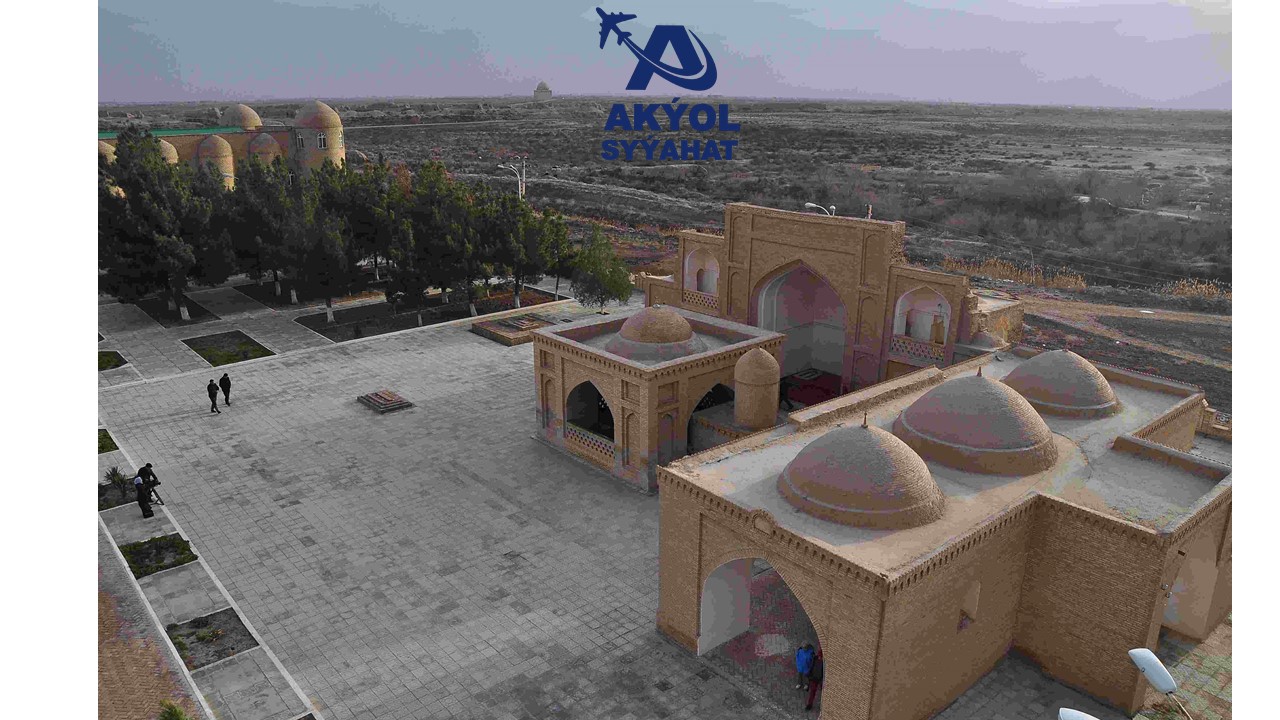
Soltan Sanjar Mausoleum most majestic architectural monument of Merv is Sultan Sanjar mausoleum called "Dar-al-Akhir" ("Otherworld"). His whole appearance it represents the highest achievements and flourishing Seljuk power. Sultan Sanjar Mausoleum is located in the center of the settlement Sultan Kala. Nearby are large monumental buildings - the palaces of Seljuk rulers and a mosque.
Great and Less Kiz fortress small fortresses with corrugated, if folded in the crease, napodobye accordion, walls. They put on the earthen ramps with mild slope. Small windows are hidden in the folds of the walls. At the top of the wall terminate toothed battlements, which are almost did not survive.
Askhabs associates of prophet Mohammed were called - Bureid ibn Al-Khuseib al-Aslami and Al-Khakim ibn Amr Al-Gifari. After death, places of their burial places were local sanctuaries around of which in XV century representatives of dynasty Timurids have constructed a religious complex.Their tombs from a black marble are decorated by a relief groove with vegetative ornaments and inscriptions. Behind tombs two cost restored aivans.
Gyaur Kala fortress In Turkic languages, "Gyaur" means "infidel", referring to those who do not practise Islam. The name of the fortress in ancient Merv, Gyaur-Kala - "Fortress of the Infidels" - was given by the Arabs who conquered it in the early 8th century. However, the fortress itself dates back much earlier, to the 4th-3rd centuries BC.
Erk-Kala fortress was the center of ancient Merv. The fortifications of Erk-Kala have sagged under earth drifts but nevertheless, have preserved their height and power. This distinguishes Erk-Kala from other fortresses. Now the height of the fortifications with steep slopes and precisely cut out towers reaches 25 - 29 m.
Yusuf Khamadany Mosque this complex was built on the burial site of Abu-Yakub Yusuf ibn Ayub born in the city of Hamadan (western Iran). Above his tomb the mausoleum, which has not survived, was erected. The destroyed structure was partially restored and reconstructed in the 19th century. The tomb of the dervish symbolizes a crypt from black marble decorated with a floral ornament and inscriptions. There is a chapel in the western corner of the mausoleum with central aivan. It is the basic part of the complex. Today Yusuf Khamadani mosque is an important Muslim temple, the place of worshipping.
Sultan Kala fortress in the 11th-12th centuries Merv became the capital of Great Seljuk state and reached the highest prosperity. By the order of Seljuk sultan Melik-shakh the city was surrounded by a fortification and moat.This fortress with the area of over 400 hectares is known as Sultan-Kala - the Fortress of Sultans. In the northeastern part of Sultan-Kala Shakhriar-ark citadel with palace complexes of sultans, administration buildings and a military barracks - was constructed.
Mohammed ibn-Zeid Mausoleum is an outstanding monument of Sultan-Kala. It is relatively small but arouses admiration by its original architectural solution. The interior of the mausoleum has a unique wall inscription in Arabian language. The letters skillfully carved from burnt bricks boldly stand out on the background of the vegetative pattern made of plaster. It’s says that the mausoleum erected above the tomb of Mohammed ibn - Zeid, the representative of Shiit branch of Islam, the descendant of caliph Ali in the fifth generation in 1112-1113.
The History Museum in Mary houses an extensive collection of approximately 40,000 exhibits, showcasing the historical and cultural heritage of Turkmenistan. Covering an area of 10,000 square metres, the museum offers a comprehensive insight into the country's history through the ages. Founded in 1968 as the Mary Historical and Revolutionary Museum, the first exhibition opened in 1974. In 2010, the museum moved to a new building in the shape of an eight-pointed star, with a magnificent fountain at its centre. Statues of prominent Turkmen historical figures adorn the entrance. The exhibition area covers 4,000 square metres in six halls.
Mary Regional Library opened in 2011.The Mary Regional Library of Turkmenistan is the main cultural, educational, and research center on the Mary River. It serves as a large book depository with over three million copies, housing nine reading rooms, a museum of Turkmen books, and an observatory. This library serves 600 readers at a time. It is known for its unique tulip-shaped dome, which houses an observatory with a powerful telescope.
Monument to the poet Mollanepes. The monument located in the center of Mary city. He lived in the 19th century.
The Pokrovskaya Church in Mary, Turkmenistan is a historic, red-brick Orthodox church built in 1900. Located in the center of the city, it is a model of early 20th-century Russian colonial architecture with ornate, detailed brickwork.
Night at the hotel.
-
BREAKFAST
08:30 - after breakfast drive to Gonurdepe by 4x4 vehicle. Gonurdepe located from Mary city 90 km.
Gonur Depe (2000 BC) is the largest settlement in historical Margiana, also known as Margush. Spend the afternoon walking among the remains of a sprawling city that contained a palace, temples with fire altars, living quarters, ovens and extensive burial grounds, including a royal tomb. Gonur Depe (Gray Hill), a huge city and temple complex in the Mary region of Turkmenistan, was discovered in 1972 by an archaeological expedition led by Viktor Ivanovich Sarianidi. The largest settlement in ancient Margiana, Gonur Depe belongs to the Bronze Age (3rd millennium BC) and appears to have been a major center of the Zoroastrian religion.
Return to Mary city.
After dinner walking night tour in Mary city
Night at the hotel.
-
BREAKFAST
09:00 - drive to Turkmenabat city (250 km).
Upon arrival in Turkmenabat city and check-in hotel. Rest time.
Turkmenabad is located at on the banks of the Amu-Darya River, near the border with Uzbekistan. Türkmenabat is at the center of Lebap province.
15:00 - visit Ancient Amul fortress.
Amul is the ancient and medieval site at the outskirts of the modern Turkmenabat city.The most ancient period of occupation refers to the I-IV cc. A.D. At that time it occupied the area of about 50 ha and was a part of Kushanian kingdom. Srating from the IV c. A.D. the period of crisis is observed. After Arabian conquest Amul was revived and by the IX c. became one of the largest centres of international trade which promoted appreciable increase of the town. Amul, the capital of Middle Amudarya region, was an important transit point on the Great Silk Road. Here there were crossed two international routes – land and river ones. The land one led from Merv to Bukhara and China. Another land way led to the north, to Khorezm. The second route was Amudarya itself by which the goods from India through Afghanistan had been delivered. According to archaeological data Amul of that period consisted of shakhristan inside of which there was a citadel (ark), and outer town with 3 gates: northern, southern and eastern ones. In 1220 Amul was destroyed by Mongols. The next significant stage of its life started in the XV c. when the town had been called already Charjui. The town plan of that period survived practically till 60-ies of the XX c.
Night at the hotel.
-
BREAKFAST
09:00 - drive to Dayahatyn Caravanserais (184 km)
Dayahatyn along Great Silk Road: The Great Silk Road is a grandiose trade route that links the East and West and became the cause of origin of many unique cities, architectural structures, customs and even states. Preserving the memory of times of the past grandeur, the cultural monuments of Turkmen people stand on the spaces of Turkmenistan. They are the witnesses of history of trade, spiritual and cultural ties of our ancestors with the people of the Eurasian continent.Caravanserais played a special role in international trade. One of the most significant Turkmen monuments of this kind is Dayahatyn on the left bank of Amudarya in Lebap province. Fortress built by Tahir ibn Hussein - the founder of Tahirids dynasty, was preserved in outline to this day. However, already in the Seljuk period, it changed its function, becoming Dayahatyn caravanserai.Dayahatyn caravanserai is the typical monument of architecture of X-XII centuries.
Return to Turkmenabat city.
After dinner night city tour in Turkmenabat city
Night at the hotel
-
BREAKFAST
09:00 - drive to Farap/Alat border (40 km).
You will cross border.
We hope you liked our tour and you will come again
Included
- Accommodation in mentioned hotels on DBL/TWIN sharing
- Breakfasts at the hotels
- Services of A/C comfortable transport with professional driver as per the program
- English and Russian speaking guides
- Domestic air ticket: Ashgabat-Mary
- Daily 5 bottles of 0.5l water per person
- Entrance fees to mentioned sights per program (excluding photo and video charges at sights)
- Visa support to Turkmenistan, registration and travel pass
- Travel tax
- Handmade souvenir per person
Excluded
- Visa consular fees and processing expenses 80+15 USD per person, when obtained at land border (subject to change, nationality dependent)
- Turkmenistan migration tax 14 USD per person
- PCR nose test 33 USD
- Photo and video charges at sights
- An early check-in hotel
- Lunches and dinners
- Beverages
- International air tickets to / out of Ashgabat
- Travel Insurance
- Extras, not indicated in inclusions
Customer Support
We have a professional customer support team and always accompany you on every trip.